Well, we finally got to working in Peru after years of thinking, planning, consulting, slogging through a pandemic, and so on. So by Sept. 2021 we had finally arrived, and being a compulsive spannerer I knew I would need some sort of mechanical project, as I love metaphors for redemption and resurrection (the Bible's framework will do that to a man). My good wife (I have only one, just to be clear), who has tolerated all sorts of motorcycle projects in the past, was quite clear that she didn't want me motorcycling around Arequipa, where we live in Peru's southern Andes. Can't really blame her, either; the streets are rough, the kerbs made of basalt, and the traffic fairly lawless and uncompromising.
So that meant no motorcycle projects... because we all know that if I was to restore one, then of course I would be tempted beyond what I could bear and ride the thing. So this meant I was either looking for (i) an ex-military helicopter, or (ii) something with four wheels.
I had noticed quite a few promising options quietly rotting under their layers of volcanic dust around the streets of Arequipa, but the problem with most of these jalopies is that they have no paperwork. And having the correct paperwork here in Peru is *very* important, esp. if you are an extranjero like me. Without the paperwork, you can't prove you are the owner, and so if they day ever comes when you face a roadside check of your paperwork, then you could end up simply having the vehicle confiscated. And also, if the day ever comes when you want to export the vehicle, you've got no chance of getting it out of the country.
Above: Here's one such jalopy: GMC cab, Ford tray, early Volkswagen wheels, flathead Ford V8 donk.
I did enquire about this beastie but the owner said it was his next project. Good man!
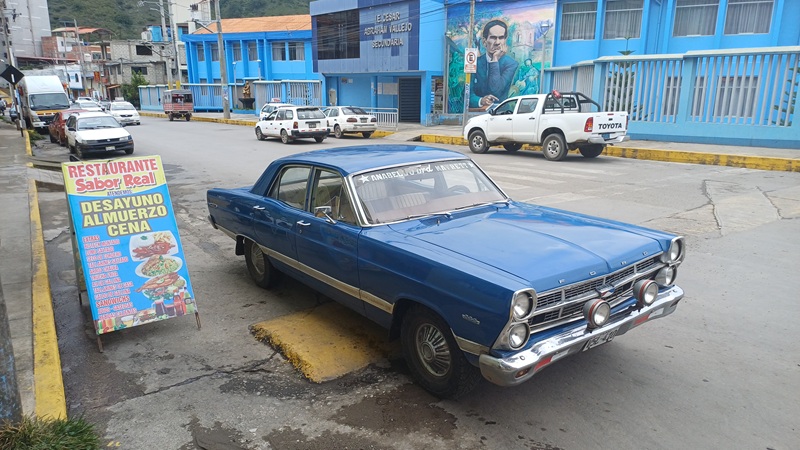
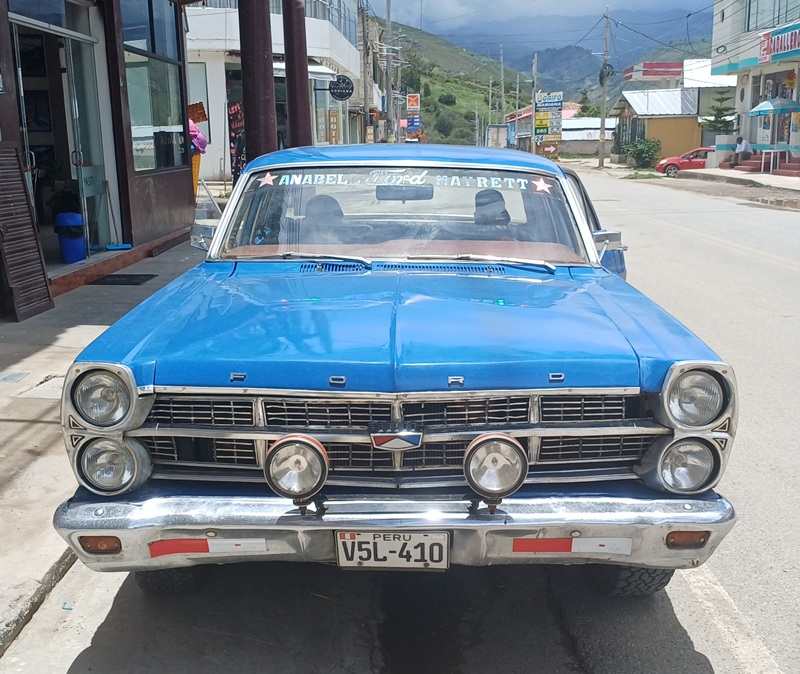
So I started trawling a few Peruvian online car sale sites. I was quite open-minded about possibilities, but was already leaning in the direction of a pre-80's F100 or something like that. But then what should I spy but a 1967 Ford Fairlane, for which the owner claimed he had all the correct paperwork. I went and checked the car out, and happily it was mostly all there and -- even better -- also needing a ton of work! This would guarantee hours (decades?) of spannering, problem solving, and the satisfaction of knowing that anything I did to it would pull it back from the brink of oblivion. The motor (original 289 V8) started easily, ran smoothly, and no smoke!
Next step was to co-opt Peruvian mate Carlos, jack-of-all-trades and master of about 15. He checked over the paperwork (as I didn't have a clue as to what constituted correct paperwork or not), declared it all pukka, helped negotiate a bit of a discount, and the deal was done!
Next day with Carlos at the wheel (I hadn't yet run the gauntlet of getting my Peruvian drivers licence) we drove the Fairlane back to my place (video courtesy of Annabell, daughter of previous owner):
I use the term "drove" rather loosely, as it kept on conking out -- and so at one point I had the crazy fun of pushing my own yank tank through the occasional intersection while Carlos chuckled away in the driver's seat, much to the delight of all the Peruvian spectators! Thankfully the return trip was mostly downhill and old Fairlanes respond to gravity rather well.
Naturally, after getting it home I hooked into the fuel system. The previous owner, trying to enhance the beast's fuel economy, had installed a carbie from a Daewoo Tico. That's right, a carbie from a 0.8 litre engine, grafted onto a 4.7 litre engine... I'm sure he got his increase in fuel economy, but let me assure you it was at the expense of just about everything else! Thankfully the original carbie -- an Autolite 2BBL -- came with the car, so I managed to find a refurb. kit for that and back in it went. The other major thing to address was that, for some reason (soon to become clear) the fuel tank had been disconnected, and a small 3-gallon homemade fuel tank installed in the boot (trunk). This was ditched, as it was very good at filling the boot space with petrol fumes, and no way would I want to light up a Cuban cigar anywhere near that.
I pulled out the fuel tank and checked it over. It was almost spotless inside, and I was wondering why it might have been decommissioned when what did I see but a cracked solder joint around the fuel line spout, where it entered the sender unit cap. That was easily fixed, sender re-installed, fuel tank filled, and yes now it is fuel tight once again.
Of course, the smooth-running motor was a short-lived phenomenon. It started running rough, missing, etc. and so it was time to dive into the ignition system. The more I poked around the motor, the more I realised that despite being 55 years old, there was so much of the original factory equipment still present with "FoMoCo" logos everywhere. Yes, all looked original in the ignition department too, so I just replaced the lot... leads, plugs, coil, rotor button, dist. cap, points, condenser -- I just went to town. I also dismantled and cleaned the dizzy; a little bit of free play evident in the shaft but nothing excessive. After working my way through all that, we had a smooth runner once again.
Since buying the old tank I have tackled all sorts of other things, too: fresh wiring from the fuel tank sender, repaired the front seat adjustment mechanism, reco'd the water pump, some fine tuning of the carburetor, new set of (all terrain!) tyres, fabricated a retainer for the spare tyre in the boot, etc. Fixes in the near future include a proper set of seat belts, new shockies all 'round, new exhaust system, conversion to floor shift (from the worn out and hopeless column shift) -- just to name a few. The cosmetics will be the last cab off the rank!
Above: poking around under the hood with Carlos.
16th Aug. 2022... Well, apart from all the shockies being utterly flogged out, the fact that the driver's side front shock was also completely disconnected from the suspension wishbone wouldn't have helped to reduce the pogo-stick effect! In the end I couldn't find exactly the shocks I wanted here in Arequipa, but I did get a set of front and rear that only needed a bit of modification to install. Now I'm just waiting on the arrival of the gear shift conversion kit (from the column to the floor) and then we can start cruising the town Stay tuned!
12th Oct. 2022... Well fiiiinaly the floor shift conversion kit arrived, and it works great. The hardest bit was trying to figure out where the hole in the floor had to go. I measured it all carefully several times, but still I was about 4" too far forward :-/ So I just had to patch up some of the steel flooring, but it was all good in the end. I've also changed out all the brake slave cylinders and the master cylinder. In the process of doing that I found so many loose chassis and suspension bolts it was scary. Funnily enough the car is much less rattly than before!
So now the Fairlane is, at last, a daily driver. It's fun being in such a barge in Peruvian traffic; people see this thing coming and they just give way :-D ... it's nice to have a little respect.
21 Nov. 2022... the radiator saga
Well the original 'FoMoCo' radiator was just springing more and more minor seeps and weeps, so it was time to replace the faithful old thing. Now normally this wouldn't present a challenge... but here in Peru, everything is a challenge if you're not a native inhabitant! No one stocks parts for the old Fords any more, and importing parts is a nightmare (don't ask me how I know). But there are hundreds if not thousands of talented artisans around here who fabricate car parts every day, radiators included. But how do you know who's a good one and who's dodgy? You don't. So in the absence of any direct recommendation I wandered off into the automotive wilds of Calle Puno (street with hundreds of auto shops) to see who I could find. Somehow I knew this wasn't going to be straight forward...
Found what could be a reputable shop. Spoke with a guy who seemed to know what he was talking about. We agreed on the specs (3-row, of course, and all made out of brass), I emphasised that if there was any problem or changes needed, to LET ME KNOW, etc. Of course, that is not what happened. After putting some money down up front, I went back the next day and was greeting by a radiator that was about 1/2 - 1" narrower than the original. It wasn't 3-row, of course... I don't know what core stock they used, but it wasn't standard automotive stock -- maybe for mining equipment? I don't know. I hate these situations. Why can't people do what they say... and if they hit a problem, just phone you like they agreed? Well, this is Peru... not that dealings in Australia can be much better, let's face it.
So in the end I haggled the final price down, and left with this radiator that clearly wasn't up to spec. What to do... Realising that the old Fords didn't seem to come with radiator shrouds as original fitment, I figured that if I could make a shroud to suit the radiator then that might stand a decent chance of lifting the overall efficiency of the cooling system. So that's what I did. Making a shroud out of galvanised tin and pop rivets, along with seams of silicone (more to stop rattling and vibrations than anything), was straight forward enough. The only mishap was when the drill bit snapped and I sent the jagged end of the broken bit spinning into the side of my thumb at 1000rpm or so :-D Once the bleeding was under control, I finished the cowling with a coat of satin black to cover the multitude of minor sins that accompany any first-time fabrication job
And the result? Yes, she runs cool enough... the water temp. needle sits right in the middle of the gauge in the afternoon heat and the usual peak-hour choked Arequipeñan traffic. So that's about 85-90 deg. Celsius, which is fine. On the open road we get 80-85 degrees, cool as a cucumber. So the saga has ended well, and also my wisdom and experience in wheeling and dealing with the automotive artisans of Peru has been raised into the bargain. Onwards and upwards!
Identity problem solved...
Well I had found the chassis number stamped into the cross member in front of the radiator, but no amount of internet sleuthing and forum trawling could help me make sense of it. But then I managed to spot the original ID tag affixed to the driver's door, just above the latch -- superbly camouflaged under about 3 layers of paint. Here it is in all its glory:
See that? Assembled under licence in Peru! Cool az, eh
27 Dec. 2022 ... 'twas a coupla days after Christmas
Picked up some friends from the Arequipa airport today, and it struck me how I must be kind of OLD. Because I think a car like a '67 Fairlane is perfectly normal, makes complete sense, and is exactly the way a car should be. But anyone 30 or so years younger thinks they're exotic! And as for the young fella peering over the back seat there, well he's probably going to grow up with electric monstrosities, and may not want to confess to his friends that one time he rode in the back of a -- HUH! -- liquid dinosaur slurping V8. The times, they are a changin'.
7 Sep. 2023 ... thar she blows!
Well we'd taken the old tank down to Vitor and back a couple of months ago, and the car had performed quite well. It's a trip of about 60kms, and overall downhill, going from Arequipa's 2300m to about 1200m. Last time the engine had got a bit on the warm side while hauling back up the long higher-altitude straights through the desert to home, but nothing catastrophic happened and I thought the cooling system was handling things rather well. So this time when we cruised down to Vitor I wasn't expecting any problems. Only this time we had some camping gear loaded into the capacious boot (= trunk for all our N.American friends) and the weather was a bit warmer...
Of course it was that long generally uphill run home that brought us undone. I was giving the old girl plenty of berries on the way, because I don't believe in molly-coddling a vehicle and "what could possibly go wrong" etc. But with one eye on the temperature gauge I saw it happen: from about 95 deg. C, SUDDENLY the needle leapt up into the red zone, then a couple of nanoseconds later a geyser of green coolant erupted out the driver's side of the bonnet (= hood) and I pulled her over to the side of the desolate highway and turned the motor off. Hmmm.
We had 4 litres of water in the boot but this wasn't enough as the coolant bottle and radiator outlet had spewed out just about all of the coolant into the rarefied Andean air. But we had enough drinking water to top up the radiator (one must have one's priorities right) and so we thought all would be well if we just took it easy the rest of the way home.
Well thankfully our German colleague Siegfried -- with over 30 years' experience handling the challenges of travel in these parts -- pulled up behind us and strongly counselled us to head back to Vitor to top up fluids (ours and the Fairlane's), and he would stick with us just in case we needed a tow back to Arequipa. This turned out to be a very wise piece of advice, as once I restarted the Fairlane the temp. needle was very quickly hitting the red zone again.
Clearly the car wasn't going to be making it back into Arequipa under its own steam (sorry), so Siggy broke out his well-used tow rope and the Fairlane made its way back home behind the venerable old Landcruiser.
This 30km slow trip gave me plenty of time to ponder the car's symptoms: it had to be a problem with the thermostat. Sure enough, the next day I pulled it out, popped it into a pot of boiling water, and the rotten thing didn't open in the slightest. At that moment I pieced together what must have happened: 1. The current sub-standard radiator led to things getting toasty... 2. so that as we barrelled up a long high-altitude hill... 3. the thermostat failed (likely its seal let go, allowing all the expansion wax to escape instantly) and so it snapped shut... 4. which instantly sent the water temp. into pressure-cooker territory... 5. and so the temp. gauge scooted into the red faster than a speeding bullet... 6. which was then followed by that geyser of green coolant blasting out the side of the bonnet... 7. and thus the ultimate shame of being towed home, but which gave my brain the chance to mull through the diagnostics.
So Monday morning I trekked off into the automotive wilds of Arequipa (aka Calle Puno, Peruvian mecca of all things automotive), and bought new a thermostat, new radiator hoses (including a pair of spares for stashing in the boot), and a few bottles of coolant. I already had a new thermostat housing waiting in the wings (thanks to Pablo, one of my reg. parts mules from the USA), so it was all installed and everything is working the way it should once again. But the root cause must be addressed: that sub-standard radiator I had installed last year. It took some doing but I finally found an eBay crew who are willing to ship one to Peru. So when it gets here we will hopefully be a step closer to "Andes proofing" the old tank. Stay tuned...
A Road Trip for the Ages -- 20-25 Feb. 2026
In late 2025 Peruvian pastor mate Edgar and I hatched an excellent plan to take the Fairlane up to Lima and back to lob in to a church conference. I spent quite a bit of time prepping the old beast for the trip... tyre patch kits, spare parts of all sorts (wheel bearings, ignition spares, radiator hoses, full gasket kit, etc.) as well as a comprehensive set of tools, including a torque wrench.
The plan was to stick to the coast... from Arequipa to Camana, then Atico, Challa, Nazca, Ica, and Lima. We allowed 3 days for what is normally a 2-day trip up to Lima, just in case we had to change out head gaskets or wheel bearings, etc. by the road side. And also because the Fairlane only has the original 3-speed gearbox, so cruising at much over 100kph starts to push the old 289 a bit harder than I like.
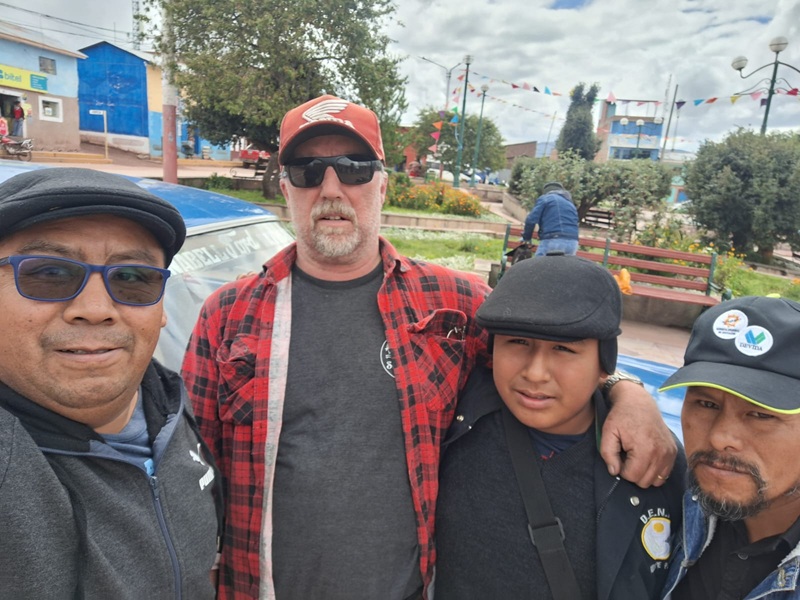
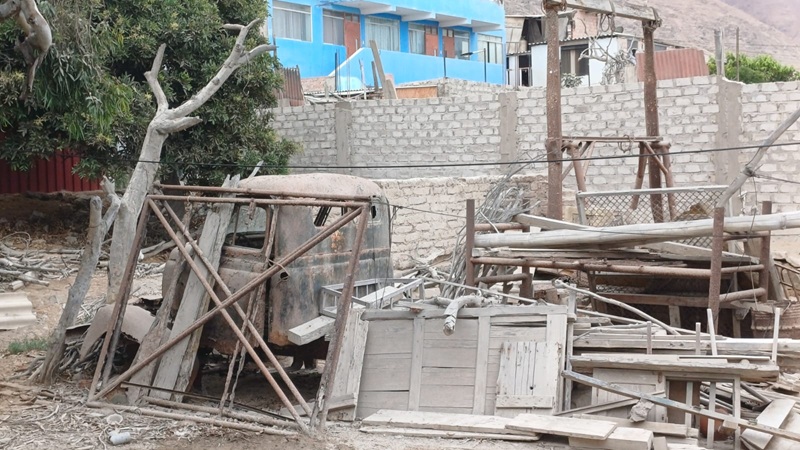
So off we went, leaving on the Friday morning. We got down to Camana on the coast without any trouble, but for some reason the car had started backfiring whenever we were coasting downhill, or when I took the foot off the pedal a bit. This was a great source of mirth for my Peruvian mates (Edgar, his son Andre, and Ubaldo), and every time the KABOOM went out of the exhaust pipes everyone let out a huge cheer! It was particularly funny whenever we came into towns and villages on the way north, as one good backfire and all the street vendors would run for cover. We stopped for the night in the coastal fishing town of Atico. While wandering around a few side streets, I spotted my next possible project:
By now I was a bit over the backfiring, and was wondering what it could be... maybe an exhaust manifold or header pipe leak? I'd given the car a basic tune-up session (points, timing) the day before we left Arequipa, and I was scratching my head. So in Atico I switched to a richer set of main jets i.e. the original Autolite #46's (I run a leaner set here in Arequipa, #42, where the altitude is about 2300m), and checked the headers but couldn't see evidence of any leaks. The next day would tell if it was lean running that had been causing the backfiring...
Next morning we set off and the backfiring was no better; if anything, it was worse. Hmm, was it a burnt exhaust valve? Not much to be done but continue on to Nazca regardless. Between Atico and Challa we went past a gang of about 5 vultures loitering by the side of the highway, no doubt waiting for the next batch of juicy tourists on bicycles. As we went past the Fairlane let out another huge KA-BOOM!! and the vultures just about took off leaving their feathers behind! Tears of laughter all 'round and the Fairlane barrelled on to Nazca.
We stopped for the night at Palpa (north of Nazca) and the next day set off north towards Ica and Lima. Just north of Palpa, on the old Pan Americana, is the notorious Palpa Tunnel. This single-lane marvel is always, err, interesting to navigate, because traffic goes both ways and if a truck or something comes in the other end, then you have to decide who gets to reverse all the way back out. Yes, there are rules about who has to give way, but in reality (as with pretty-well all Peruvian road rules) these are negotiable. These days a couple of ladies have stationed themselves at the lower (Palpa) end of the the 3-400m tunnel, and they do a pretty good job of coordinating the traffic. Naturally they gratefully receive the occasional Peruvian Sol for their efforts! Video below of us going through the tunnel, courtesy of Edgar.
I should say that Edgar and Ubaldo both earn their crust as taxi drivers in Arequipa. This, like many incomes here, is not exactly fantastic, so like most Peruvians they do not have the luxury of being able to do much travel in their own spectacular country. It was the first time in their lives travelling along most of the roads we went on; and their first time seeing a lot of the amazing sights this land has to offer. So that's why they were ooh-ing and ah-ing going through the tunnel. And while the coastal desert and cliff-top highway along the Pacific is amazing, they were going to be totally gobsmacked by the altiplano, and all the snow-capped mountains and canyons that lay ahead. I have to say that I felt privileged to give these guys an opportunity to see these landscapes that simply have to be seen to be believed.
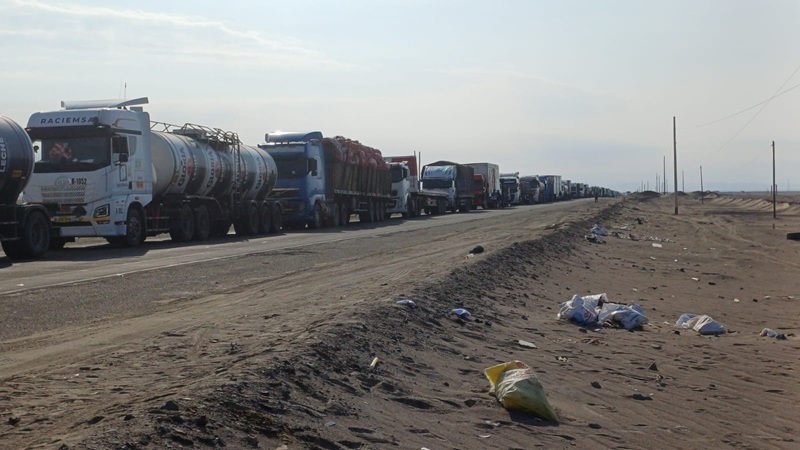
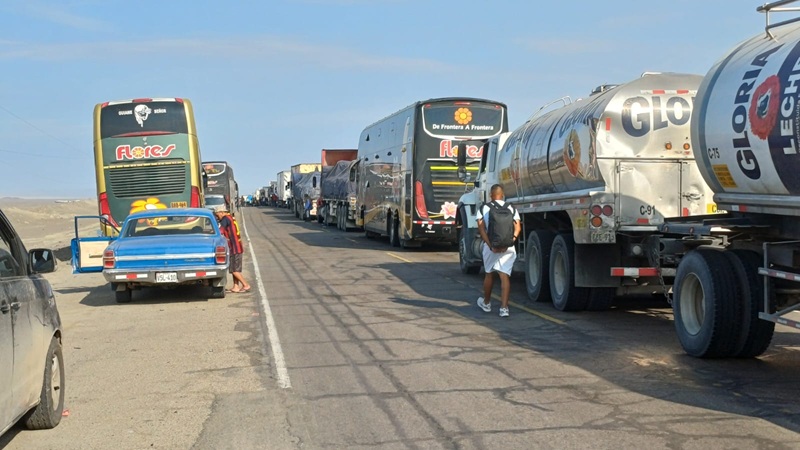
Coming out the other end of the Palpa Tunnel we were on the highway to Ica; yes, Lima was now in reach! But before too long we were confronted with an enormously long stationary queue of trucks and other traffic. The problem? Well, being the rainy season up in the mountains, during the night there had been one of the usual deluges that caused an enormous huayco (mudslide) to come barging down the valley, and it had cut off the highway. We tried skirting the cars by going off road, but as the old beast is no 4WD and rather hefty, we very nearly bogged it in the sand. I asked Edgar what we should do... wait for the highway to be cleared, or admit defeat and head back to Arequipa? Edgar said that each night more rain in the Andes would simply bring down more mudslides, and the reality is that the highway would not be cleared for days, if not weeks.
"Well, we have some time to spare then," I said. "Why don't we make a real road trip of it, and cut back inland through the Andes on the return trip to home in Arequipa?" Everyone was unanimously in favour of this, of course! So back to Nazca we went. But before we went any further, I had to fix that backfiring. By now I was wondering if it could be a spark plug lead shorting out onto another lead or something like that. So back in Nazca we started hunting around for some auto shop who could sell us at least one new spark plug lead for diagnostic purposes. But, being a Saturday, a lot of the shops were shut. But one gent helpfully suggested that a couple of blocks away there was a mechanic, Antonio, "who knows these cars" he said, nodding towards the Fairlane.
So we tracked down Antonio. He came out of his workshop, a somewhat unlikely looking figure. He was certainly rather plump, shall we say -- wearing nothing but a pair of shorts, and sporting a magnificent set of man boobs. We flipped up the hood on the car, and as he leaned across the radiator -- which I can assure you was pretty toasty hot -- his man boobs came to rest upon the scalding hot aluminium of the upper radiator. Now, if that had been me (I don't have man boobs in any case) I can guarantee you I would have let out a blood-curdling scream. But not Antonio. No, he just slowly leaned back, stood upright and -- dignity fully maintained -- sauntered off to find a T-shirt. What a man!!
He asked us what the problem was... and then he just went straight for the distributor. With me in the cockpit starting up the motor when asked and shutting it down, in about 3 minutes Antonio said it was fixed. He said it had just been a timing problem; all he'd had to do was re-gap the points and give them a bit of a clean. This had me puzzled but... well, never mind, it was fixed! That was probably the quickest 30 Soles Antonio had earned in a while -- not that I begrudged him a single one! Off we went and the the backfiring was gone. And here I'd been over-thinking the problem all along... was it a burnt valve? problem with a spark plug lead? main jets too lean? Nope, none of the above. One screw driver and 3 minutes, and Antonio had it sorted. Legend! But still it was niggling me... how had the timing gotten itself out of whack? It wasn't until our stop in Puno that things would become clear.
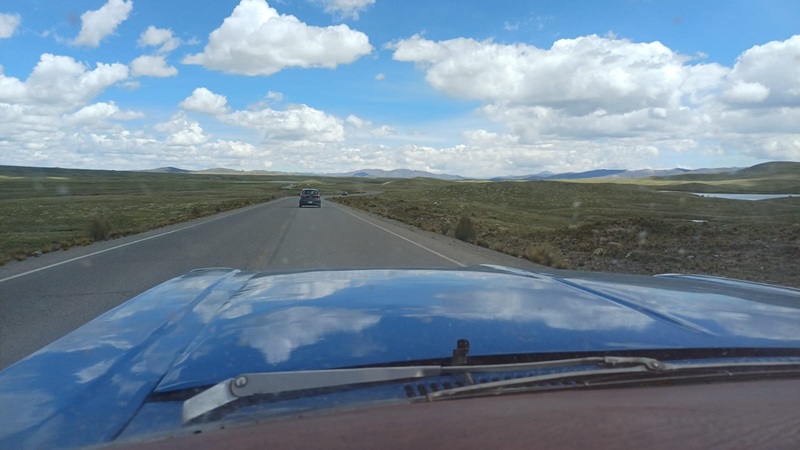
Anyway, now we turned the prow of the land yacht inland towards Abancay. The highway between Nazca and Abancay is one of the world's most marvellous routes... a steep winding road all the way up to about 4400m altitude, across the altiplano and then down the eastern slopes of the Andes towards the Amazon Basin. When we got up to the Peruvian roof of the world, the temperature plummeted to somewhere around 5 deg. C, and we drove straight into this stonking huge storm. Rain, hail, thunder, and columns of lightning were spearing down into the landscape around us. Every time the lightning struck everyone in the car let out a huge cheer (much as they had with the backfiring), although Ubaldo did take some convincing that we were safe in the metal cage of the vehicle. The Fairlane, in the meantime, just kept on going without a missing a beat. It was so cold that my toes were going numb, but the glorious old beast just shrugged off all the rain and hail and seemed eager to at least get us to Abancay. But it had been a long day, it was getting dark, so we pulled in for the night in the town of Chalhuanca, about 2 hours short of Abancay.
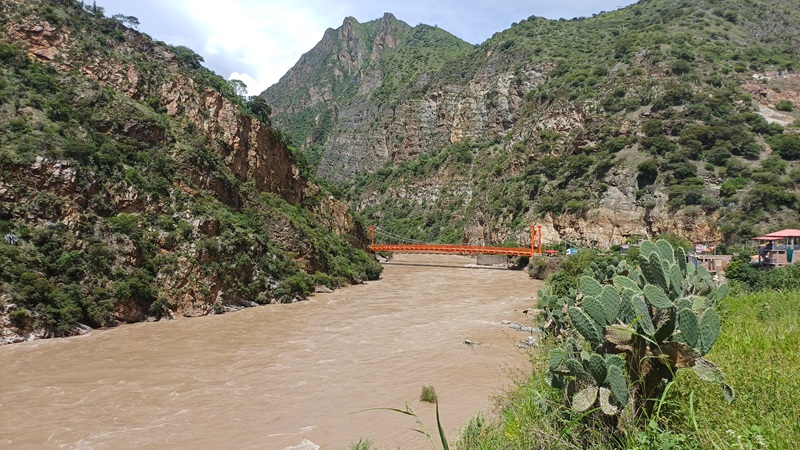
The next day between Abancay and Cusco we had the privilege of seeing the mighty Rio Apurimac in full flood. 'Apurimac' means 'great speaker' in Quechua, and refers to the roar it makes going through the canyons. This was Peruvian landscape at some of its most spectacular. It's as though your camera just doesn't have enough megapixels to do it any sort of justice. And as you drive along, on so many of the mountainsides you can see loads of old Inca terracing. They must have been a tough and ingenious lot indeed.
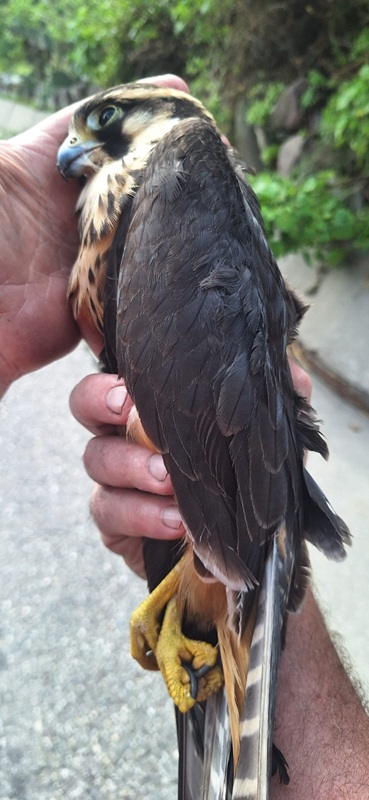
While scooting down a canyon alongside the river, we saw a bird clip a power line and fall onto the road ahead of us. Alas, it was a beautiful falcon, but dead as a door nail. Laid the poor bird to rest in the bushes and on we went towards Cusco.
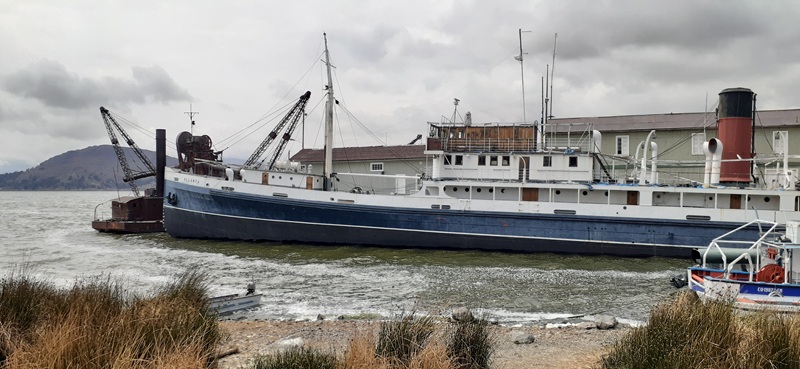
Now, we avoided staying in Cusco as, even though it was the tourist off-season, it's still a pain to navigate and not a cheap place to stay. We opted instead for a night in Edgar's old stomping ground of Sicuani. Our stop for our next (and final) evening was Puno on the shores of lake Titicaca. This is great old city, and for me at least one of the highlights is the old steam ship 'Ollanta' moored down at the docks. It hasn't moved since the 1980s, I believe, and is slowly rotting away. A bit of a shame but who knows... maybe some entrepreneur can take it on, swap out the old steam engines for diesels, and start operating cruises on the highest navigable lake in the world? We can only hope.
It was while taking the Fairlane to a cochera (secure parking lot) for the night that the motor just suddenly conked out. Now, a sudden stop means an electrical/ ignition problem. Thankfully we were on a quiet back street, so up went the hood and I started fiddling around. With the spirit of Antonio whispering in my ear I flipped off the distributor cap and, rotating the motor a bit by hand, I soon saw the problem: the points had no gap! Huh? Out with the feeler gauges and the screw driver, and they were soon set at 0.017" once again. But still the car wouldn't fire. A bit more fiddling around and I popped in a spare condenser, and it started right up first flick of the key. So what had happened? Well, the 60-year-old screw that retains the points has become a bit feeble and it had let things slip shut, and that seemed to have fried the condenser into the bargain. So for the time being the screw is done up super tight, until I can be bothered to fit a new one...
We had thought about spending another day travelling via Chivay (further across the altiplano in the Colca Canyon), but to tell the truth we were all a bit tired by now and ready for home. So we took the more direct route back to Arequipa, through Condoroma and then Imata. This took us through the highest elevation of the road trip -- 4700m -- but as usual nothing fazed the Fairlane. At these altitudes, like all vehicles, it does suffer the loss of some power, but it didn't foul any plugs even though the carburetor was on standard (sea level) jetting. You can't ask for more than that. Anyway, as we wound our way back down into Arequipa it was into the pouring rain and a city trying to cope with terrible mudslides and flooded roads.
But the final accolades must go to the Fairlane... 5 days, 2000 kilometres, between sea level and up to 4700m, from warm dusty coastal desert to freezing altiplano and down the eastern slopes of the Andes, through rain and hail, along open highways and up tight winding dirt roads, this car did it all. And the fuel economy, in spite of the steep roads and lack of oxygen for a lot of the trip, worked out at an impressive 16 mpg. Oil consumption over the entire trip was less than a litre of oil. What a car! Next road trip, I aim to take it across to the selva (eastern jungle region) with another bunch of Peruvian mates and see what adventures we might have. Stay tuned!


 Stay tuned!